
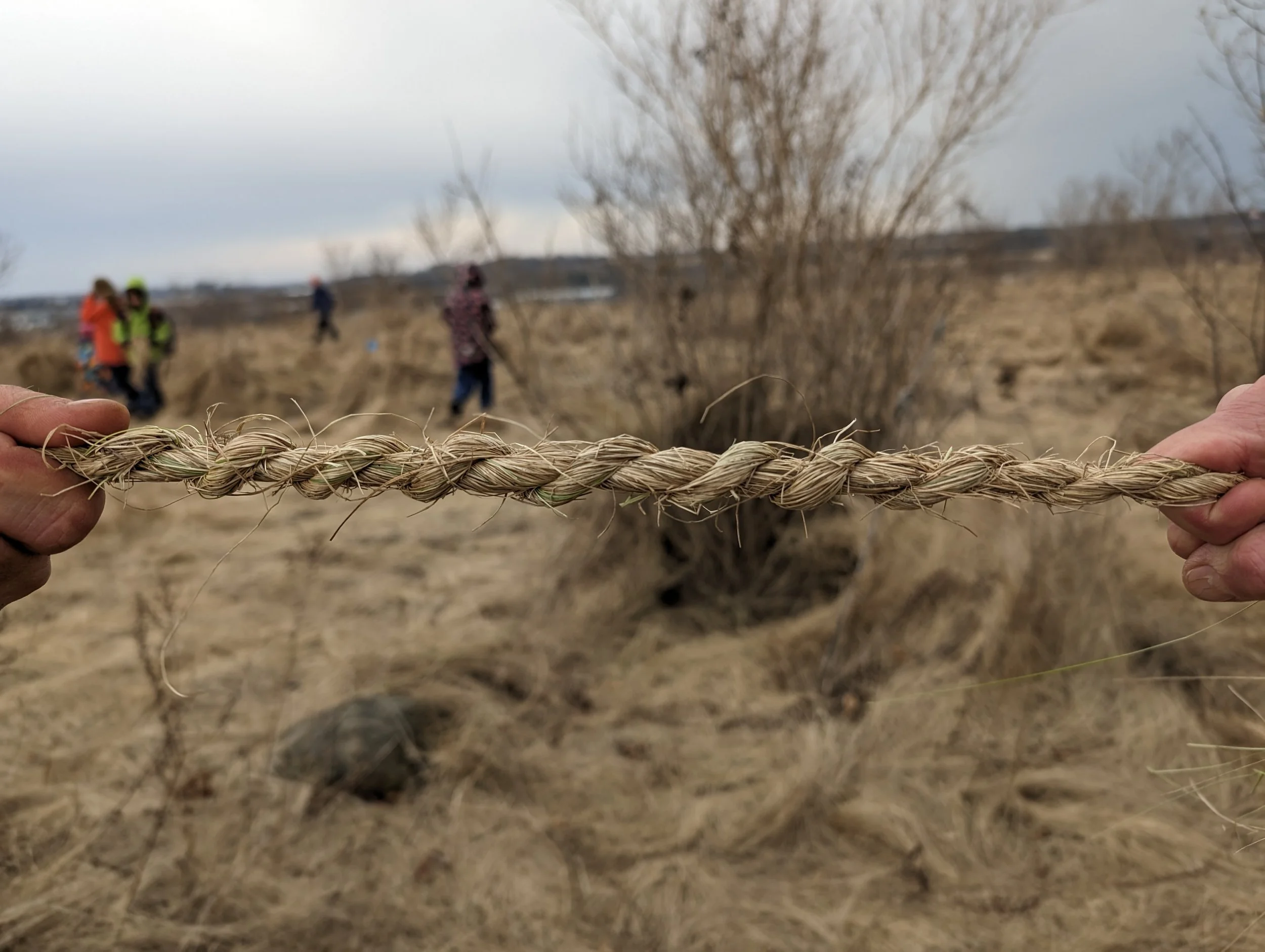
My Philosophy of Cordage
Reverse Wrap cordage is learned in the hands before the brain. It forces you into your body, to watch and try before you think. It's an amazing, meditative skill that can be practiced anywhere. That's why I love it.

Reverse Wrap cordage is learned in the hands before the brain. It forces you into your body, to watch and try before you think. It's an amazing, meditative skill that can be practiced anywhere. That's why I love it.
I spent years trying, and failing, to learn reverse wrap. The skill only came to me when I stopped getting ahead of myself, quieted my mind, and watched. It's a slow skill, accessed through patience and humility. Cordage represents what I love about nature connection. Watching. Learning silently.
Everything is made of fibres. Plants, trees, mushrooms. The proteins we are made of, fibers. Our communities, family trees, the webs that weave us together, connections of fiber. String theory describes a universe held together by fibre. If everything is fibre, then everything can be corded. And if everything can be corded? Everything can have knots.
If we are all made of rope, and we are all knotted, I believe we must understand these knots. Bowline knots, slip knots, hitches, bends, all of them. To be “all knotted up“ isn’t a bad thing. Knots are what connect us.
What is a Forest School?
Forest School is play-based and child centered, where the educators take cues from the students as to what they would like to investigate. The children involved in Forest School gain many insights, including an enhanced knowledge of their local environment. Forest School learning can take place on or off of school grounds and can happen on a weekly basis or more or less often (Harris, 2017). When children are outside, they can learn differently - with more physicality. The children are able to run and explore. Forest School lends itself to child-lead learning, or inquiry-based learning (Harris, 2017). At the Guelph Outdoor School we call this nature immersion programming.
Forest School is an outdoor learning method that originated in Scandinavia and is gaining traction throughout the UK and in Canada. Forest School is play-based and child centered, where the educators take cues from the students as to what they would like to investigate. The children involved in Forest School gain many insights, including an enhanced knowledge of their local environment. Forest School learning can take place on or off of school grounds and can happen on a weekly basis or more or less often (Harris, 2017). When children are outside, they can learn differently - with more physicality. The children are able to run and explore. Forest School lends itself to child-lead learning, or inquiry-based learning (Harris, 2017). At the Guelph Outdoor School we call this nature immersion programming.
At Forest School, students are engaged in an active questioning process about nature and embrace discoveries that drive their learning. This approach stimulates curiosity and ensures that children are actively engaged in their learning, rather than passively receiving knowledge. The inquiry approach is experience-based and results in learning that is fun, memorable, and well consolidated. The research findings suggest that blending Forest School concepts with mainstream settings contributes to children’s social, cognitive, emotional and physical skill development through experiential learning using play (Coates & Pimlott-Wilson, 2019).

The physical benefits of nature immersion programs
There are many physical benefits to outdoor learning and education for students. They include fresh air, change of scenery and physical movement. Children have a natural need to move to help expel energy and allowing them to do so helps them better embrace new learning when they return to the classroom (Alphonso, 2013). Being outside and unrestricted by four walls, children have the freedom and opportunity to move freely and engage in many different types of physical activities. “Engagement in a range of physical activities not only [presents] children with the opportunity to learn about the natural environment... but also [helps] children learn about how to navigate a challenging environment” (Coates & Pimlott-Wilson, 2019, p.31). Spending time in forests has been shown to boost the immune system, increase energy, decrease anxiety, depression and anger and reduce stress and bring about a state of
relaxation (Li, 2018, p.64). Outdoor education allows children to develop both their fine and gross motor skills with running, balancing, digging, and climbing, as well as more intricate work with clay, rope tying and hand crafts (Walmsley, N. & Westall D., 2018).
Enhanced social skills gained from nature immersion programs
Learning in Forest School brings about an increase in collaboration and teamwork for students. In traditional school settings children are limited to working independently or with others seated in close proximity to themselves. Working outdoors with no set seating, children can expand their social network and learn more about their peers and how to work together. In an outdoor setting, students are often observed working “alongside peers constantly on joint activities,
aiming to achieve mutual goals” (Coates & Pimlott-Wilson, 2019). The breaking down of physical barriers in an outdoor setting appears to have a correlation to breaking down social barriers as well.
Building a connection to nature and the environment
Being in the natural environment and using the different senses of sight, smell, touch and sound truly immerses someone in that place. “Immersion in the natural environment...exposes the young directly and immediately to the very elements from which humans evolved: earth, water, air and other living kin, large and small” (Louv, 2008, p.98). Students who spend more time outdoors, have a deeper understanding and appreciation of the environment which translates into their learning indoors as well. Constable (2019) makes the connection between increasing children’s knowledge of the outside world and their roles as caretakers of the earth. “These children are the same people who in thirty years’ time will be expected to solve the problems associated with global warming...” (p. 3). It is vital that we give students the opportunity to become familiar with the natural world. Anderson, Comay, & Chiarotto (2017), list two main criteria for developing environmentally aware citizens; giving repeated opportunity for unstructured outdoor play and being with an “environmentally aware adult” (p. 67).
How can forest school assist in children's social and academic engagement at school?
Forest School helps students develop the skills to both look after themselves and their classmates(Constable, 2019). Constable noted in her book that there had been noticeable improvements in the students behaviour after outdoor learning. Sisson and Lash state that “long, uninterrupted time outdoors allows children to develop strong relationships with nature, teachers, and one another” (2017, p. 10). Strong relationships between student and teacher can improve student engagement and increase their chance for success (Student Identity and Engagement in Elementary Schools, 2011). “Forest Schools and environmental attitudes: A case study of children aged 8-11 years” (2015) mentions that the majority of children are kinesthetic learners (37%) and Forest School allows for those learners to use their hands to
create, whether that is mixing solids and liquids in an outdoor kitchen or digging for worms. They are able to learn in a way that is best suited to their needs. The article continues by stating that after participating in a multi-week Forest School program, the students demonstrated increased self-esteem, confidence, improved social skills, motivation, and concentration (Turtle, Convery, & Convery, 2015).
The connection between Forest School and inquiry-based learning environments
Forest School or outdoor learning pairs well with inquiry-based learning by providing a stimulating environment in which children can fully participate. Inquiry based learning “promotes engagement, literacy and deep learning for all students, especially reluctant ones, and invites them in the classroom project as fair and necessary participants” (Wilhelm and Wilhelm, 2010, p.39). The engagement aspect of learning is key here, being in the outdoors and having access to natural materials to work with has been shown to increase student engagement. In one study it was noted that “it became apparent that what [Forest School] offered children was the opportunity to engage in experiential, hands-on learning that engaged all of their senses in the learning process” (Coates & Pimlott-Wilson, 2019, p.30). Through an ever changing environment with many available stimuli, an outdoor setting goes hand in hand with
increasing student interest. Having students who are engaged with their work and the information they gain from it, helps them form a deeper understanding of the construction of knowledge.

References
Alphonso, C. (2013, September 23). Schools looking outside to inspire students. The Globe and Mail. Retrieved from https://www.theglobeandmail.com
Anderson D., Comay, J., & Chiarotto, L. (2017). Natural Curiosity 2nd Edition. Montmagny, QC: Marquis Book Printing.
Coates, J & Pimlott-Wilson, H. (2019). Learning While Playing: Children’s Forest School Experiences in the UK. British Educational Research Journal, 45(1), 21-40, DOI:10.1002/berj.3491
Constable, K. (2019). The Outdoor Classroom in Practice, Ages 3-7. Oxon: Routledge.
Elliot, H. (2015). Forest School in an inner city? Making the impossible possible. Education, 43(6), 3-13. http://dx.doi.org/10.1080/03004279.2013.872159
Harris, F. (2017). Outdoor learning spaces: The case of forest school. Royal Geographical Society, 50, 222-231, DOI:10.1111/area.12360
Li, Dr.Qing (2018). Forest bathing: How trees can help you find health and happiness. New York, NY: Viking.
Louv, Richard. (2008). Last child in the woods: Saving our children from nature-deficit disorder. Chapel Hill, NC: Algonquin Books of Chapel Hill
Walmsley, N., & Westall, D. (2018). Forest School Adventures: Outdoor Skills and Play for Children. East Sussex: Guild of Master Craftsman Publications Ltd.
Wilhelm, J. D., & Wilhelm, P. J. (2010). Inquiring Minds Learn to Read, Write, and Think: Reaching All Learners through Inquiry. Middle School Journal, 41(5), 39-46, DOI: 10.1080/00940771.2010.11461738
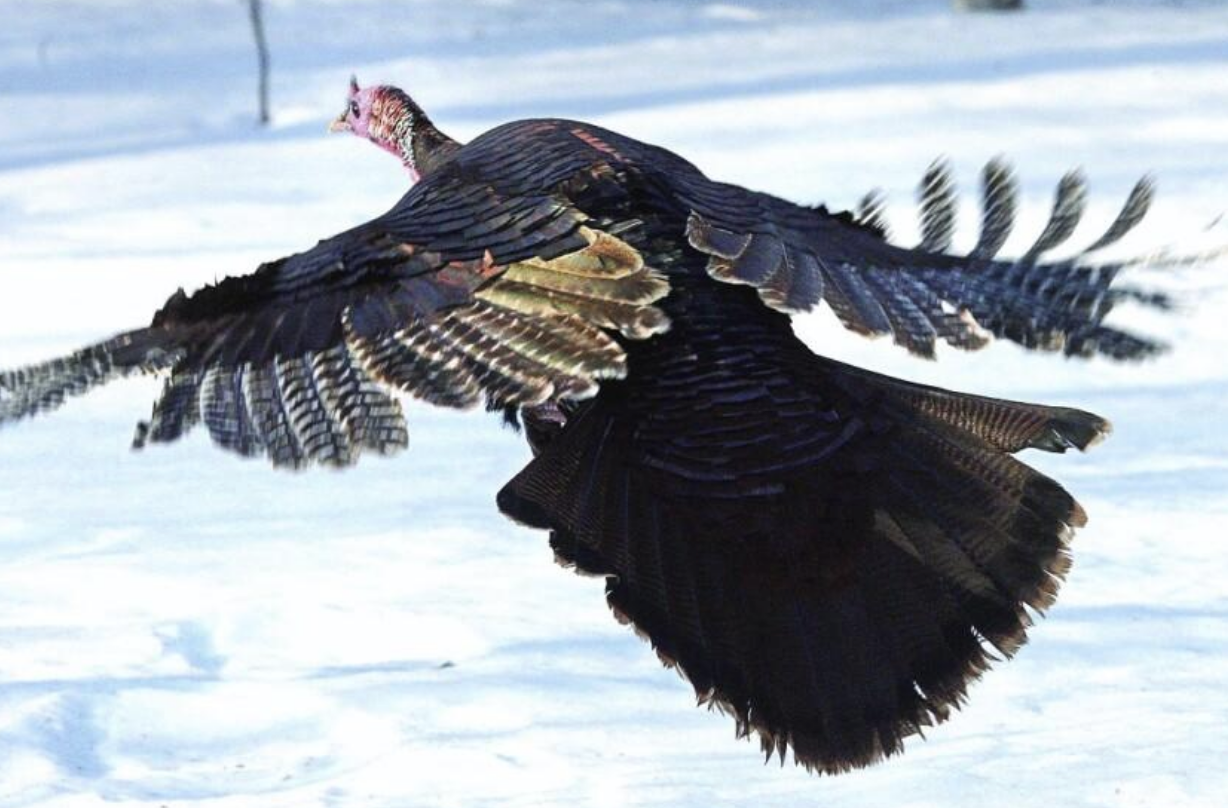
On the Trail of a Turkey - A Winter Break Camp Story
It was the first day of the Winter Break camp. We had just had a little more than a dusting of snow come down over the past couple days. Enough snow to find some fresh and older tracks in the snow. I knew we were in for some good tracking today. Did the kids know? I am not sure, but none of us could have expected what was going to happen today!
It was the first day of the Winter Break camp. We had just had a little more than a dusting of snow come down over the past couple days. Enough snow to find some fresh and older tracks in the snow. I knew we were in for some good tracking today. Did the kids know? I am not sure, but none of us could have expected what was going to happen today!
The day started out pretty normal, the first day of camp excitement, meeting some new kids and seeing the “usuals” that come to all of our camps. Going in for the opening circle, signing a song or two and giving the kids the usual spiel of our 3 agreements and what to expect during the week of camp. Of course we had to play a couple rounds of tree charge and have our snacks before we headed out on our wander onto the land. With a brief stop at the porta potties, we were finally set for adventure!
Today both the bigs and littles groups just happened to be headed in a similar direction at the same time, so we all decided to wander together in a group of around 25 people. We were headed for the Pines!
A straight walk to the pines would take any casual walking adult about 5 - 10 minutes, but when you have little feet and legs and lots of layers on to shield you from the cold, it can take you quite a while longer.
As we passed the railroad tracks, I tuned into my body radar, sensing where I wanted to lead the group. I spotted an area that I often have seen skunk tracks and decided that we would start there. Before we made our way through the old fence and into the Plantaintion of old Scots Pines and younger White Pines, we had to have a chat. A group of 25 people can make a lot of noise and I was keen on seeing something today! We took a few moments to talk about listening to the sounds of the forest and being quieter so we do not scare everything away. We talked about moving slower so we don't just bulldoze our way through the forest.
When they were ready, we headed in…..
It wasn’t too long before we came upon our first sign of wildlife in the snow. It was a somewhat large area of ruffled up pine needles on the forest floor. It looked as if something or more likely multiple things were scratching and ruffling up the ground. There was no snow on top of the needles that were scratched at, but snow on the ground that was untouched.
I had a pretty good idea of what had caused this but I wasn't ready to tell. It was time for questioning the kids. What do we think happened here? What animal could have done this? Why would it want to do this? The answers came piling in, some were close or pointing towards the answer and others were way off. It didn’t really matter. The point was they were beginning to learn how to read and interpret the story of the tracks and sign on the landscape.
This sign on the land looked somewhat fresh to me, as in, it had happened this morning. I knew there was more to find close by, so I was still not ready to give any answers.
We continued moving and had not gone 30 feet before someone found a set of tracks. Multiple sets of tracks. The tracks had 3 toes pointing forward and 1 smaller toe pointed backwards but slightly on an angle. The kids knew right away that it was some kind of bird and a big bird at that. Guesses started flying out until someone finally shouted,”It's Turkey!” They were right, it was a Turkey and those marks in the pine needles we had just come across were the Turkey’s scratching at the ground to look for food.
Fresh Turkey Tracks! Let the Trailing begin!!

We had a brief talk again about trying not to disturb the area by staying quieter and moving a bit slower. Also about not stepping on the tracks. Once you step on the tracks they are destroyed for good!
We started moving again, but this time was different, some of the kids were in stalk mode and their awareness was now on finding these Turkeys that could be close by. The hunt was on!
We followed the tracks as they moved through the different sets of Pine plantations. Plantation turned into meadowy Buckthorn and sparse Tamaracks and back into Pine plantainton. The Turkeys would stop in each strip of Pine plantation to scratch around looking for food. We were counting about 5 or 6 different sets of Turkey's tracks.The longer we followed the tracks, the fresher the tracks and scratches looked. We stopped to examine another area that had been scratched up and to wait for some of the little legs and very slow walkers in the back. We started to experiment with the pine needles by ruffling up untouched ground to see how it compared to the areas that were scratched by the Turkey’s. We examined how much fresh moisture was on the soil compared to how much was starting to freeze (the first set of scratches we found, the moisture in the newly uncovered soil had started to freeze over). Both the Turkey scratches in this new area and the areas that we had just scratched were looking very similar (still wet compared to frozen). Which meant, those Turkey’s were not too far away as the moisture had not yet had time to freeze.
I was no longer leading this tracking expedition, the kids were. The enthusiastic ones in front could barely be contained. They were fully in this!
We trailed them to the place where the Plantation ends and it turns into a very wet meadow area. We lost the trial and were well over an hour into our wander at this point. We knew it was about a half hour straight walk back to camp. It was getting close to the time to call this.
Some of the kids were determined to find the trail and continued looking while the instructors talked about what to do next.
“I found them!” I found the Turkey tracks!” One of the children yelled from the meadow area. This wasn’t over just yet!
I was not ready to turn back and some of the children were not going to give up on this trail.
We took a short break and came up with a plan. Those that wanted to continue tracking could go ahead for a little longer and those that did not want to go, or who were tired could stay in that spot, rest or play a couple rounds of Owl Eyes.
About 15 of us decided to carry on and find those Turkeys!
We were on a trail that we use often, that leads to a very small bridge over a creek and leads out to what we call the abandoned house.
Most of the Turkey’s cut off the trail into the long grass area but one stayed on the trail. We followed the lone Turkey not 50 feet from where we left the rest of the group. I was in front and stopped because I no longer saw the tracks. One of the kids spotted the trail as it took a sharp turn off the main trail and into the grasses. We all took about 2 steps in that direction and boom! That Turkey burst from its hiding stop in the grasess about 5 feet from where we were all standing!

(Bob King / rking@duluthnews.com)
For a moment we were all awe struck (of course after the initial jump back reaction of a very large Turkey bursting from the grasses hidden close to your feet and making an explosion of a sound with their wings)!
After that moment of awe, it was an eruption of enthusiastic yips,howls and I told you so’s.
I expressed to the children how rare that moment was. It is not often that as a group we actually trail an animal and get to see it. Especially from 5 feet away!
We had all just experienced something profound on that adventure, something ancient, something all of our ancestors did at one time. We did something that is embedded into our DNA so deeply, it enlivens our body and mind as we do it. We did something simple that day. We tracked an animal… and hopefully those kids were touched by that experience just enough to continue on that journey towards becoming a student of the natural world, and continue to follow the tracks and trails of the animals.

Crow and His Marbles
Across the road, a few hundred feet in front of me, a big crow caught my eye. He was perched on a lamppost, and all his black-feathered body language told me he was focusing intently, and with some crafty delight, on the road beneath him…

Crow and His Marbles
A surprise encounter leads to a meditation on animal intelligence
Years ago, I was walking down a quiet city street around this time of year, maybe a little earlier. The sky was blue, and it was warm enough that I didn’t need a coat that afternoon. I remember feeling especially grateful for that, knowing that these warm days were not going to last much longer.
Across the road, a few hundred feet in front of me, a big crow caught my eye. He was perched on a lamppost, and all his black-feathered body language told me he was focusing intently, and with some crafty delight, on the road beneath him. ‘Wily crow,’ I thought, ‘Up to his old tricks.’ (Though I’d no idea what they were). Trying to see for myself, I followed his gaze with mine, down to the road. Beneath him, there on the asphalt, I saw what looked like a large, green golf ball. ‘A giant marble? A tennis ball, maybe?’ I got closer and, for some reason, I paid more attention to the tree near the lamppost: it was a Black Walnut tree, and the green golf ball on the ground was in fact a ripe nut, covered in its bright husk.
As you may know, Black Walnuts are different than the walnuts you can buy in the grocery store (which are typically English Walnuts, a European transplant). Black Walnuts are a native species in Ontario. Their nuts are also edible; but, compared to their English cousins, they have more complex flavour, almost as if they’d been soaked in a fragrant rose water. There’s nothing like them. And if you’ve ever tried to open a Black Walnut, you’ll know there’s nothing like that either: the shells are outrageously tough, and it literally takes a hammer to split them – then something like a dental pick to scrape out the nut meat afterwards. The work is rewarding, but it’s work for sure.
Back to the crow now: A car drove by on his side of the road and its tire brushed against the walnut, which then went rolling slowly towards the sidewalk curb. With the car passed, the crow jumped off the lamppost and flew down to the nut, now stopped against the curb. I don’t remember exactly how, but one way or another, he moved it back to where it had just come from, pushed it with his beak until he liked where it was, and then, satisfied, quickly alighted back to his lamppost perch to resume his gleeful watch.
I stopped. I’d read about this before, but I couldn’t believe that I was actually witnessing it. Standing back, I waited for what I hoped would happen next.
It didn’t take long. Soon, another car drove by, this time running right over the walnut. Crunch. The crow, not at all sharing my surprise, dropped down again from his perch and started poking apart the mash, picking out and eating the nut meat. Then, a minute or so later, he moved another nut from the sidewalk gutter into the road and flew back up to his lamppost to wait.
From Whence This Sand?
Did you know that Howitt Park was a popular swimming hole in the 1930's? Here's how we found out…
From Whence This Sand?
A simple question unearths a surprising history
Did you know that Howitt Park was a popular swimming hole in the 1930's?
Here's how we found out:
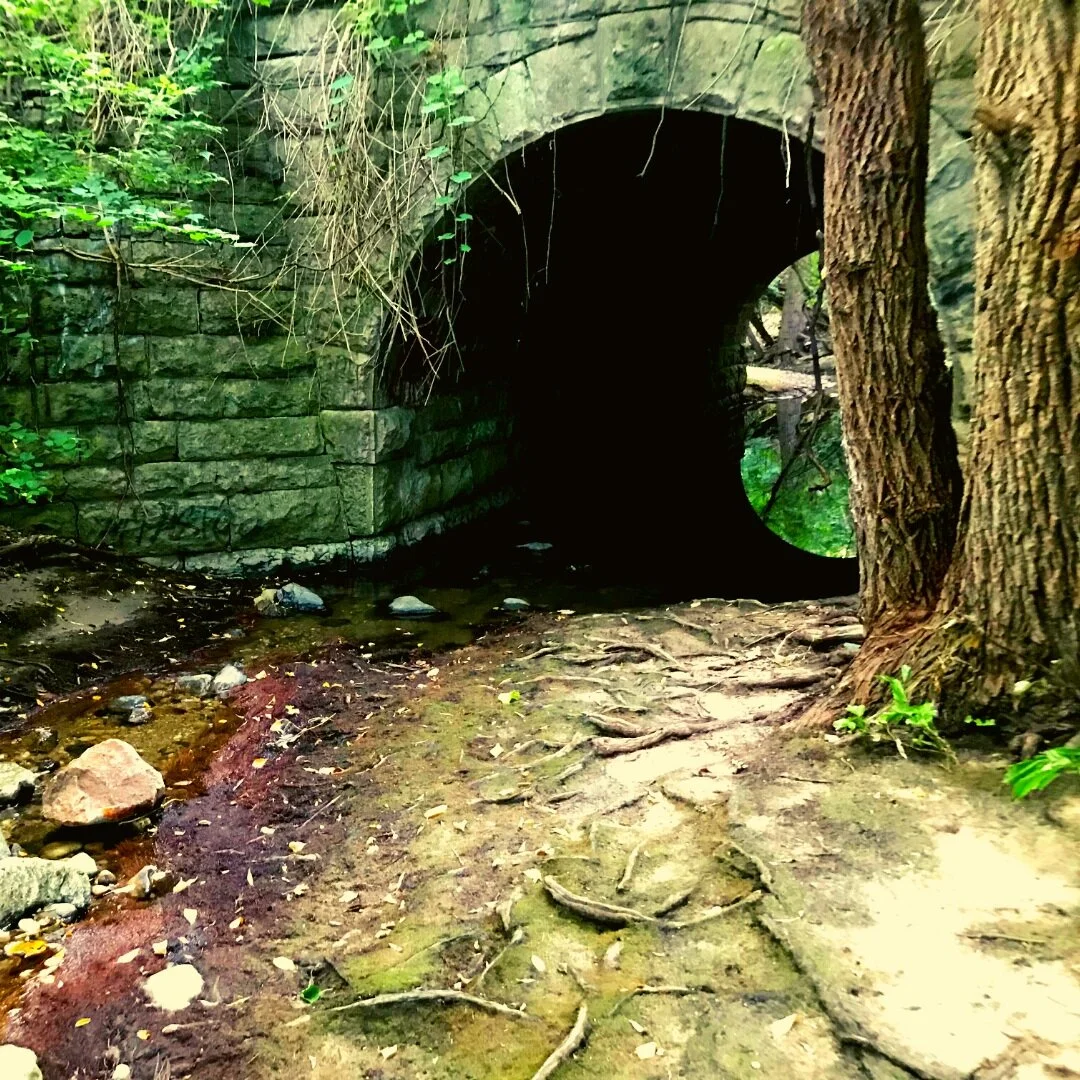
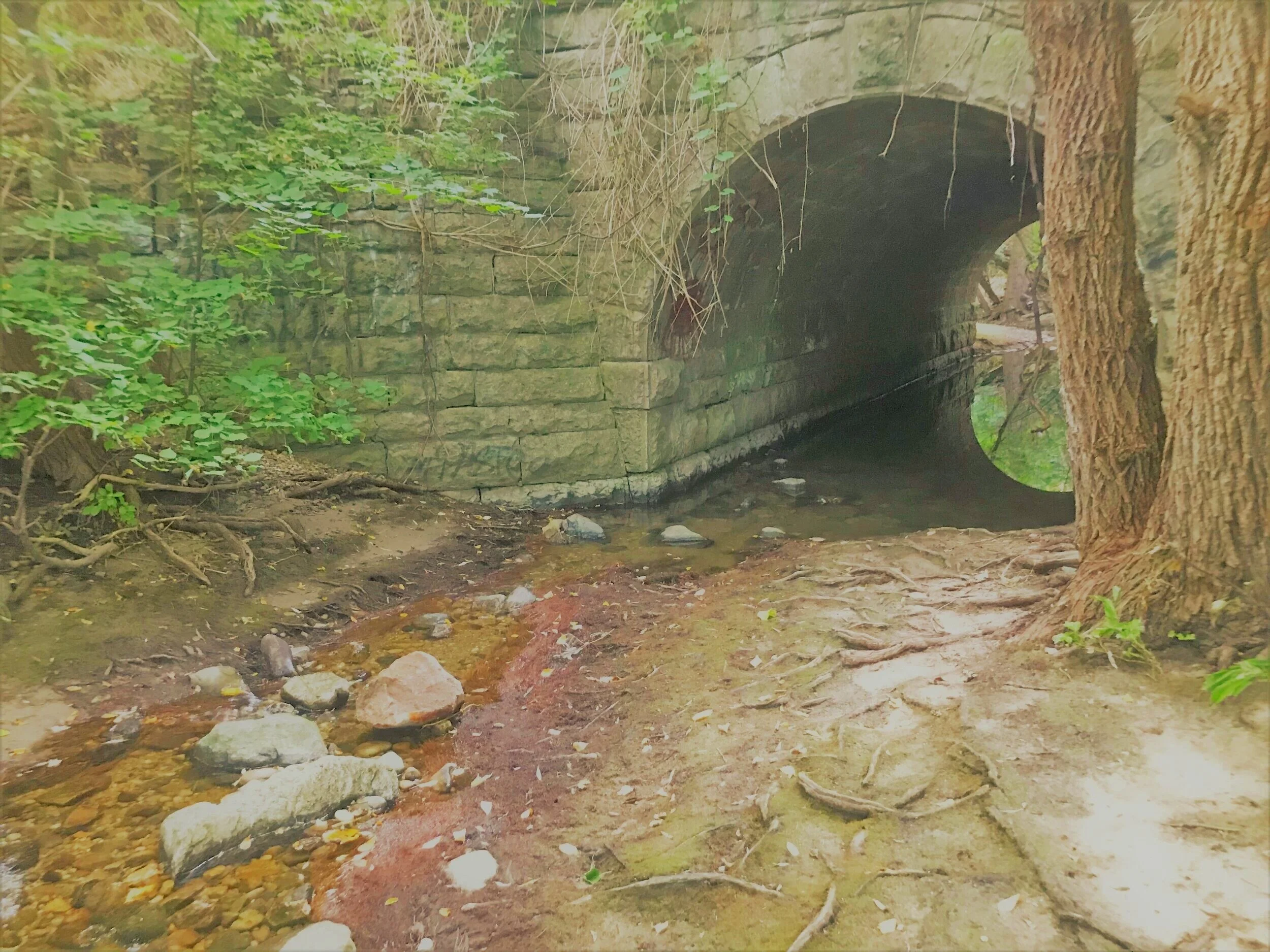
Low in one of the ravines, we came across some tracks in wet sand – A LOT of sand. Where did it come from? It didn't make sense... Follow the ravine and it leads to a cattail marsh, hedged in by dilapidated walls. Who built the walls? And why here?

Turns out the walls are part of a nineteenth-century dam, reservoir and chute system. The reservoir – known as 'Howitt Pond' – held water to feed two mills further down the hill, by Waterloo Avenue. Here’s a picture taken of that holding pond (from the 1970’s):

Nearly a century after the dams were built, in the 1930's, the city trucked in a bunch of sand around the holding pond, and community members spread it out to make a beach. There was a diving platform, and the city built some changeroom shacks, too. Here’s an image of the beach from the 1930’s:

We're still not quite sure where everything stood, how the water flowed, and where the beach was, but we're learning...

We’re amazed at how much we learned by following a simple question: Where did the sand some from?
More learning — and questions — ahead, for sure!
Shout out to CELP and Waterloo Region Record for the helpful resources. The vintage pics courtesy of Guelph Museums (no. 2013.39.300 & 2009.37.1)